
If you are comparing where to build your app, the Canada vs US question comes up fast, and the numbers alone do not tell the full story.
The cost of custom app development in Canada is genuinely lower than in the US. That is not marketing spin. It is a structural reality driven by currency exchange, talent market dynamics, and the way Canadian agencies are set up to serve North American clients at competitive rates. But the gap is smaller than most founders expect, and the way you close that gap matters enormously.
I have worked with founders who burned $60,000 choosing the cheapest hourly rate, and others who spent $45,000 with a Canadian team and launched a product that actually worked. The difference was never just price. It was how the budget was structured, how clearly scope was defined upfront, and whether the team included post-launch support in the original agreement.
This post is for budget-conscious founders who are doing real due diligence, not just Googling rates and picking whoever is cheapest. You will get actual cost ranges for both markets, a breakdown of what drives those numbers, the hidden costs nobody puts in their proposals, and a clear framework for deciding which market fits your project and your budget.
By the end, you will know exactly what questions to ask, what to watch out for, and how to stretch your development budget without ending up with a product you cannot use.
Custom app development in Canada costs between $25,000 and $250,000 CAD depending on complexity, team size, and the type of product being built. That is the honest range, and most mid-market projects land between $40,000 and $120,000 CAD.
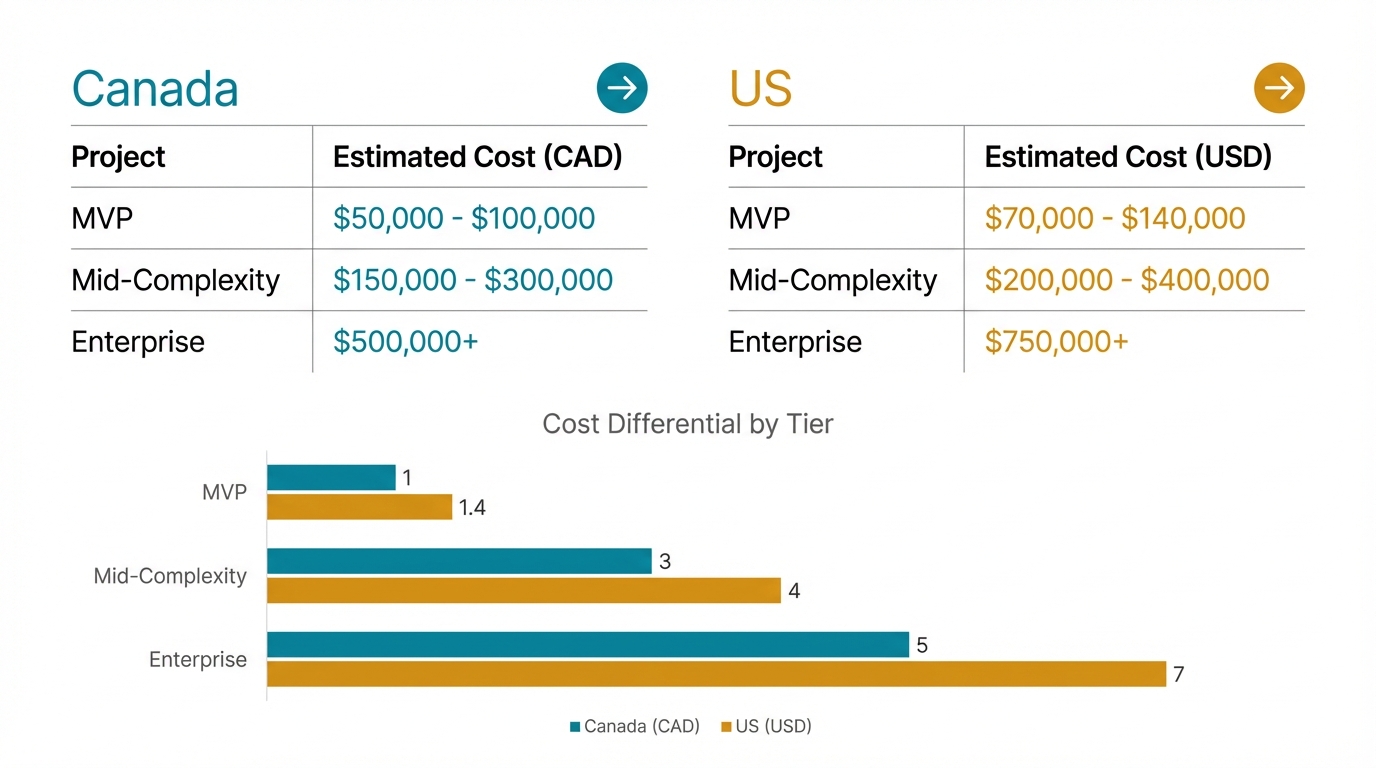
Here is how the tiers break down in the Canadian market as of 2026:
A simple MVP, one platform, basic authentication, core features, no integrations, runs $25,000 to $50,000 CAD with a reputable Canadian agency. A mid-complexity app with a custom backend, third-party API integrations, and a polished UI sits between $60,000 and $120,000 CAD. Enterprise-grade builds with complex data architecture, multi-user roles, and scalability requirements start at $150,000 CAD and climb from there.
Hourly rates for Canadian developers range from $85 to $175 CAD per hour, depending on the city and the agency's positioning. Toronto and Vancouver firms tend to sit at the higher end. Smaller markets like Halifax, Winnipeg, or Calgary often offer the same caliber of work at $95 to $130 CAD per hour.
In my experience working on digital product builds, the founders who get the best value in Canada are the ones who come in with a documented scope. Vague briefs inflate estimates by 20 to 40 percent because developers price in uncertainty. Bring a wireframe, a user story list, or even a competitor product you want to reference, it compresses your quote immediately.
One important note: these figures reflect agency pricing. Freelance Canadian developers can be hired for $60 to $110 CAD per hour, but coordinating a freelance team adds project management overhead that usually costs more than the rate savings. For a project above $30,000, a structured agency relationship almost always delivers better outcomes.
The Canadian market also benefits from strong federal and provincial support for the tech sector. Programs like the SR&ED (Scientific Research and Experimental Development) tax credit can return 15 to 35 percent of eligible development costs to qualifying businesses, a real advantage that US-based projects do not access.
Custom app development in the US costs between $75,000 and $350,000 USD for projects that would run $40,000 to $150,000 CAD in Canada. The gap is real, and it is driven by higher base salaries, bigger agency overhead, and a talent market that has been significantly inflated by the demand for senior engineers in major tech hubs.
US agency hourly rates sit between $125 and $275 USD per hour for full-service digital product studios. San Francisco, New York, and Austin agencies are at the top of that range. Midwest firms and smaller-market US studios can come in closer to $100 to $150 USD per hour, but their availability and specialization vary widely.
For a direct comparison: a mid-complexity mobile app with a custom API, user authentication, and a three-screen core flow will typically be quoted at $90,000 to $160,000 USD by a reputable US agency. The equivalent Canadian quote for the same spec usually lands at $55,000 to $100,000 CAD, which, at current exchange rates, represents a 25 to 40 percent savings.
What US firms often justify with higher rates: established processes, senior talent density, and in some cases, stronger product strategy capabilities at the agency level. If you are building a Series A product that needs to hit aggressive growth benchmarks, some US product studios bring real strategic value that mid-tier Canadian agencies do not match. That premium has a legitimate case behind it.
But for most founders building their first app, a B2B SaaS MVP, or a customer-facing product in the $50,000 to $150,000 budget range, the US premium does not translate to meaningfully better outcomes. I have reviewed post-launch products from both markets at similar budget levels, and the quality difference is negligible when the Canadian team is well-vetted.
One real cost that does not show up in US quotes: US development contracts often have higher change-order rates and more aggressive billing for scope additions. Canadian agencies, particularly those used to working with cross-border clients, tend to build more flexibility into fixed-scope agreements.
The quoted price is almost never the final price. This is the single most consistent pattern I see across app development projects in both markets, and it catches founders off guard every time.
The three biggest budget killers are scope creep, integration surprises, and post-launch neglect.
Scope creep is the most common. A founder starts with a clear feature list, then adds small things during development, a notification system here, an admin dashboard there, a reporting module that was not in the original spec. Each addition seems minor. Collectively, they can add 30 to 60 percent to the original budget. The fix is a formal change-order process with your agency from day one. Every addition gets a written quote before work starts. This is not bureaucracy, it is financial protection.
Integration surprises are the second killer. Third-party APIs, payment processors, CRMs, mapping tools, analytics platforms, often have undocumented complexity that only becomes visible during build. Stripe is straightforward. A legacy ERP system with a custom API is not. If your app needs to talk to existing software, budget an additional 15 to 25 percent specifically for integration work and testing.
Post-launch neglect is the most expensive mistake in slow motion. Founders often budget to build and nothing else. Then the app launches, iOS releases an update, a dependency breaks, and suddenly there is a $5,000 to $15,000 emergency fix that nobody planned for. A proper maintenance agreement, typically $1,500 to $4,000 CAD per month for a mid-size app, is not a luxury. It is insurance.
On the Canada vs US cost comparison specifically: US agencies tend to charge higher rates for post-launch support. Canadian agencies are more likely to offer bundled retainer arrangements that cover minor updates, bug fixes, and platform compatibility checks. Over 12 months, this difference alone can represent $10,000 to $25,000 CAD in savings.
Also worth flagging: do not overlook QA. Testing is often scoped at 10 percent of development time in proposals, but under-resourced QA produces products with critical bugs at launch. Ask every agency how they staff QA and whether it is included in the quoted timeline or billed separately.
For most founders in the $40,000 to $150,000 budget range, Canada delivers more usable product per dollar than the US. That is the direct answer, and the reasoning behind it is worth understanding clearly.
Canadian development teams operate in the same time zones as US-based clients, Eastern, Central, and Pacific. Communication is in North American English. Business culture, contract norms, and delivery expectations are aligned. You get the proximity benefit of a domestic team without the domestic US price premium.
This is where Canada separates from offshore options like Eastern Europe or Southeast Asia. Offshore teams are often cheaper at the hourly level, $25 to $60 USD per hour is common, but the coordination cost is real. Time zone gaps mean asynchronous communication, which slows decision-making cycles. Cultural and language differences create specification ambiguity. Revision cycles multiply. Projects that were supposed to take four months stretch to seven. I have watched $35,000 offshore projects balloon to $70,000 once rework, delays, and miscommunication were factored in.
Canada sits in a genuinely valuable middle position: offshore-competitive pricing with nearshore reliability.
For founders building B2B SaaS tools, internal business applications, or customer-facing mobile apps in the $50,000 to $120,000 CAD range, a Canadian agency is almost always the optimal choice. The currency differential means your USD budget stretches further. A $75,000 USD budget translates to approximately $100,000 to $105,000 CAD, which buys significantly more scoped development time with a Canadian team than it would with a comparable US studio.
Where US agencies justify their premium: if your product is in a highly specialized vertical, fintech compliance, healthcare data architecture, complex AI integration, some US firms have domain-specific expertise that is genuinely harder to source in Canada. For those situations, the premium is worth evaluating. But for general-purpose web apps, mobile apps, and SaaS products, the expertise gap simply does not exist.
At DigiBenders, we work with cross-border clients regularly. The founders who get the best outcomes are the ones who evaluate agencies on portfolio quality, communication responsiveness, and contract clarity, not just hourly rate.

Choosing the right development partner matters more than choosing the right country. A great Canadian agency will outperform a mediocre US agency at every price point. Here is a practical framework for making that decision without wasting weeks on the wrong conversations.
Start with portfolio specificity. Do not just look at what they have built, look at whether they have built something in your category. A team with three live SaaS products in their portfolio understands the specific challenges of multi-tenant architecture, subscription billing, and user onboarding flows. A team with only marketing sites and e-commerce builds will need to learn on your project budget.
Ask for a discovery process before a quote. Any reputable agency will offer a paid or unpaid discovery phase, typically 1 to 3 weeks, where they map your requirements, identify technical risks, and produce a scoped estimate. If an agency quotes you a fixed price in 48 hours without a discovery conversation, that is a red flag. They are guessing, and your budget will pay for their guesses.
Get clarity on who actually builds your product. Many agencies sell through a senior team and build through junior developers or offshore contractors. Ask directly: who writes the code, where are they located, and what is the senior-to-junior ratio on your project? You deserve a straight answer.
Evaluate the contract structure carefully. Fixed-price contracts protect you on simple, well-defined projects. Time-and-materials contracts give you flexibility for complex or evolving products but require active budget monitoring. The best outcome for most founders is a hybrid: fixed price for a clearly scoped MVP, time-and-materials for Phase 2 iterations. Make sure your contract includes intellectual property transfer clauses, data ownership terms, and a clear process for ending the engagement.
Finally, do a communication test before you sign. Send a detailed technical question over email and observe the response: speed, clarity, and whether they actually answered what you asked. If the pre-sales communication is slow or vague, the development communication will be worse. This single test has saved founders I know from months of frustration.
The cost of custom app development in Canada is genuinely lower than in the US, but the founders who get the best outcomes are not the ones who found the cheapest rate. They are the ones who understood what drives the total cost, asked the right questions before signing, and chose a partner with a track record that matched their project type.
Three things worth holding onto from this post: Canada offers a real 20 to 35 percent cost advantage over US development with no meaningful trade-off in quality or communication. Hidden costs, scope creep, integration complexity, post-launch support, consistently matter more than hourly rates. And a structured discovery process before you commit to a budget is the single highest-ROI thing you can do before writing a check.
If you are ready to scope a project or want a second opinion on a quote you have already received, DigiBenders works with founders at exactly this stage. Lets talk, bring your idea, your budget, and your questions, we will give you straight answers.