
If you have ever hired a big agency and spent the first two weeks just getting through onboarding calls, you already know the feeling. You brought them in to solve a problem, and instead you are managing a project manager who manages another project manager who eventually talks to someone who actually writes code.
This is not a knock on every large firm. Some of them do excellent work. But for Canadian SMB owners, the math almost never adds up. You are paying a premium for brand name and headcount. You are not paying for better outcomes.
The conversation around boutique software development agencies in Canada has changed significantly over the past three years. More business owners are waking up to the fact that smaller does not mean less capable. In many cases, it means sharper, faster, and more invested in your specific result.
This post is written specifically for business owners who are skeptical. Maybe you have worked with a boutique before and it went sideways. Maybe you assumed the big firm was the safe choice. Either way, this is an honest breakdown of why the boutique model consistently outperforms for clients in the small to mid-size range, and what to actually look for when choosing a partner in Canada.
We cover five real advantages, back them with specifics, and answer the questions we hear most often from business owners before they sign anything. By the end, you will have a clear framework for making the right call for your project.
A boutique software development agency in Canada delivers something a large firm structurally cannot: the people pitching your project are the people building it. That single fact changes everything downstream.
At a large agency, the senior strategist who impresses you in the sales meeting hands your project to a mid-level team after signing. That is not cynicism, it is just how large organizations manage capacity. The senior people sell. The junior people execute. You pay senior rates for junior output.
In my experience working with Canadian SMBs across retail, professional services, and SaaS, the number one source of project failure is the gap between who they bought and who showed up. Boutique firms close that gap because they do not have the headcount to create it.
A boutique team of eight to fifteen people operates differently. Everyone is a practitioner. The founder or senior lead is often directly on your account, writing code or directing creative work rather than reviewing decks. When you have a question on a Tuesday afternoon, you are messaging the person who actually built the thing.
This also changes accountability. When a large firm misses a milestone, responsibility gets diffused across departments. When a boutique misses, everyone knows exactly who is responsible and the correction happens fast. There is nowhere to hide, and that is a feature, not a bug.
Canada's tech market has a particularly strong boutique layer. Cities like Toronto, Vancouver, Montreal, and Calgary have deep pools of senior engineering and design talent that often prefer working at smaller firms. They get more ownership, more variety in their work, and more direct client impact. That talent concentration in boutique shops is something Canadian SMBs can take direct advantage of.
The agencies doing the best work in Canada right now are not the ones with the biggest offices. They are the ones with the tightest teams and the clearest focus on outcomes.
Boutique agencies are more cost-effective for SMBs because their pricing reflects actual work hours, not internal infrastructure costs. This is the part of the conversation most agency websites avoid, so let us be direct about it.
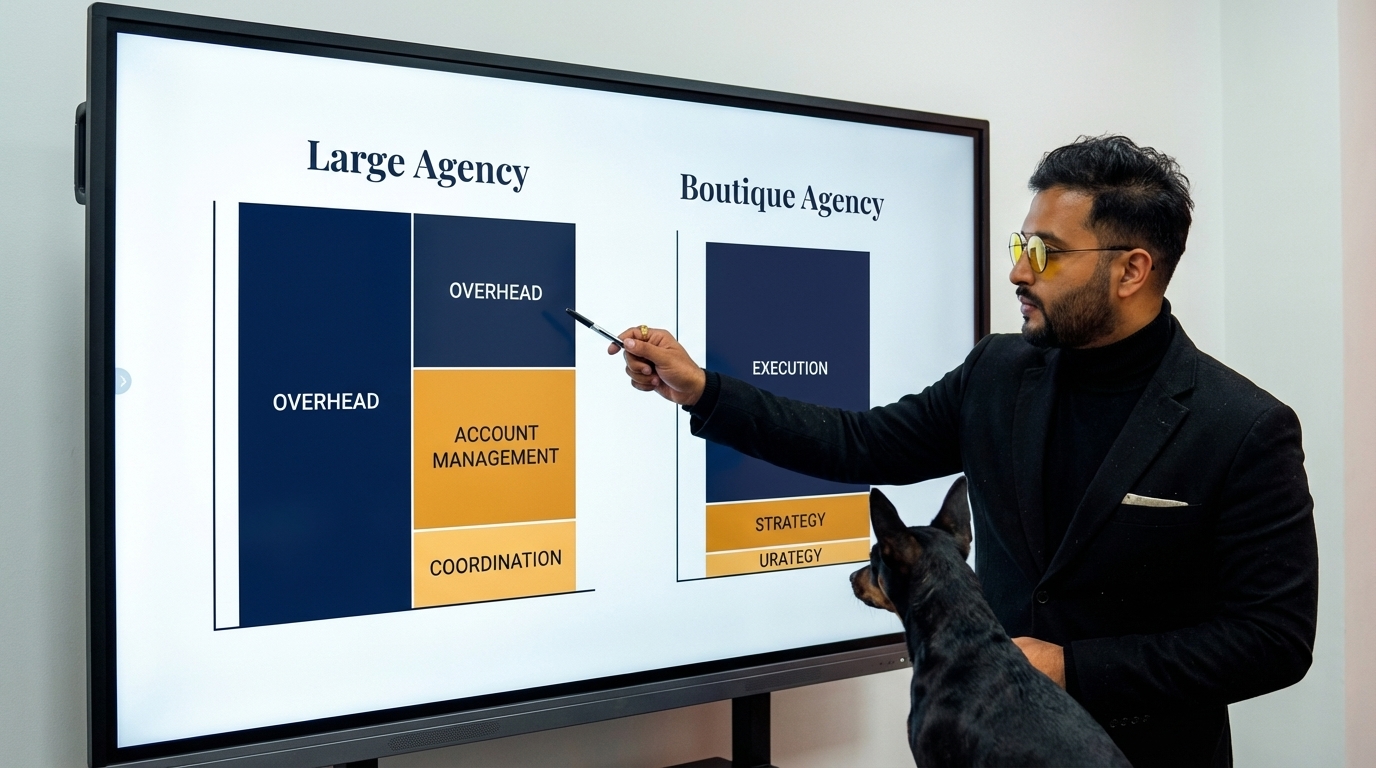
A large agency carries significant fixed overhead: floors of account managers, project coordinators, QA teams, compliance layers, and marketing departments. Every invoice you receive funds all of that, even when none of it touches your project. Industry estimates from agency operations analysts put the overhead-to-billable ratio at large firms between 40 and 60 percent. You are effectively paying two dollars for every dollar of actual execution.
Boutique agencies run lean by design. Fixed costs are low. The team is small and specialized. When you pay for forty hours of development, you are getting forty hours of development, not twenty-four hours of development and sixteen hours of internal coordination.
I have seen this play out in project after project. A mid-size e-commerce brand in Ontario came to DigiBenders after getting a quote from a large Toronto agency for a platform rebuild. The big firm quoted 180,000 dollars and a seven-month timeline. We scoped the same project, asked sharper questions about what they actually needed versus what they thought they wanted, and delivered a tighter solution for under 90,000 dollars in four months. The client got a better result because we spent the budget on execution, not process.
That is not an isolated case. The pattern holds because the cost structures are fundamentally different.
Boutique pricing is also more honest. You get granular quotes tied to specific deliverables rather than vague retainer structures. When scope changes, the conversation is direct and fast. There is no procurement layer slowing down a change order for three weeks.
For SMB owners watching every dollar, this transparency is not just a financial benefit. It is a trust signal. You know where your money is going because the team telling you is the team spending it.
Boutique agencies move faster because decisions travel through fewer people. That sounds obvious until you have experienced what it costs your business to wait three weeks for a design revision approval at a large firm.
At a large agency, a single change request typically touches a project manager, an account manager, a creative director, a developer, and a QA reviewer before it ships. Each handoff adds time, and each person needs context that was clear to the person before them. Information degrades at every step. What you asked for and what gets delivered can drift significantly by the time it reaches production.
Boutique teams cut that chain to two or three people at most. In practice, a revision request at a firm like DigiBenders gets a same-day response and often ships within twenty-four to forty-eight hours depending on complexity. The person reading your request is usually the person making the change.
In my experience, the projects where speed matters most are the ones where market timing is a real factor. A Canadian retailer launching a seasonal campaign, a SaaS founder trying to hit a product update before a conference, or a professional services firm updating their site before a major client pitch. These are not hypothetical urgencies. They happen constantly, and large agency timelines simply cannot accommodate them.
Faster iteration also produces better outcomes. When a team can test, get feedback, and adjust in days rather than weeks, the final product is shaped by real-world input rather than a single pre-launch assumption. That feedback loop is one of the most underrated competitive advantages a boutique shop delivers.
SMBs also have less tolerance for timeline slippage than enterprise clients. Missing a deadline by two weeks is a footnote in an enterprise project. For an SMB with a launch tied to a campaign or a fiscal quarter, it is a real business impact. Boutique agencies understand that because they are built around clients for whom every week counts.
The best boutique agencies become an extension of your team, not a vendor you start from scratch with every time. This compounding relationship is one of the most concrete advantages that rarely gets calculated into the decision.
Large firms treat projects as discrete engagements. When a project closes, the institutional knowledge of your business, your stack, your goals, and your customer base largely walks out with the team that was assigned to you. The next engagement often starts a painful re-onboarding process, even at the same firm.
Boutique agencies retain context because the team is small and consistent. The developer who built your core platform two years ago is still there when you want to add a new feature. They do not need three weeks of discovery to understand your codebase. They already know where the bodies are buried and how to avoid them.
At DigiBenders, some of our deepest client relationships started with a single website project and evolved into multi-year partnerships spanning brand identity, product development, and digital marketing. The client's second and third projects cost less, move faster, and produce better results because we have already done the hard work of understanding their business.
That compounding knowledge has real dollar value. Industry research from agency management firm Promethean Research found that clients working with the same boutique agency for two or more years see an average 22 percent reduction in project scoping time and a 17 percent improvement in first-draft approval rates. The context built over time is a genuine efficiency asset.
For Canadian SMBs, this is particularly valuable because your business context is specific. Regional market nuances, bilingual requirements, Canadian compliance considerations, and domestic customer expectations are not things an offshore firm or a generic large agency intuitively understands. A Canadian boutique partner who has worked in your space for years does.

Choosing the right boutique agency comes down to five specific things, and most SMB owners miss at least two of them before signing.
First, ask who is actually on your project. Get the names. Then look those people up. Do their portfolios reflect the kind of work you need? Have they done this type of project before, not just in theory but in execution? Any agency, boutique or otherwise, that cannot answer this question clearly is a red flag.
Second, ask for a reference from a client with a similar scope and budget to yours. Large agencies often show you enterprise case studies when pitching SMBs. That is misleading. A 200,000 dollar enterprise engagement is a completely different animal from your 40,000 dollar project. You want to talk to someone who paid what you are paying and got the result you are looking for.
Third, test responsiveness before you hire. Send an email or fill out their contact form and see how long it takes to get a substantive response. Boutique agencies that are serious about client relationships respond within one business day and follow up with specific questions. Agencies that take four days to send a generic auto-reply will not suddenly become responsive once they have your deposit.
Fourth, look at the depth of their discovery process. Strong boutique agencies ask hard questions before quoting. They want to understand your business model, your customer, your internal constraints, and what failure looks like for this project. If an agency quotes you within an hour of first contact without asking those questions, they are quoting to win the deal, not to deliver the project.
Fifth, verify Canadian-specific experience. This matters if your project involves data residency, CASL compliance, bilingual content requirements, or regional market knowledge. Offshore firms and some US-based agencies routinely underestimate these requirements. A Canadian boutique that has navigated them before is a material advantage.
The right partner will be as selective about taking your project as you are about giving it to them. That mutual qualification is one of the clearest signals you are talking to a serious boutique agency.
The case for choosing a boutique software development agency in Canada is not sentimental. It is structural. You get the senior talent on your project from day one. You pay for execution rather than overhead. You move faster because decisions travel through fewer people. And if you find the right partner, the knowledge they build about your business compounds into a long-term advantage that no large firm can replicate at scale.
For Canadian SMB owners, the practical filter is simple: find a boutique agency that can name who is on your project, show you references at your budget level, and ask you harder questions than you asked them. That combination is rare and valuable.
DigiBenders works with Canadian businesses that are ready to stop starting over and start building something that lasts. If that is where you are, lets talk.