• A Google Business Profile gets people interested. A website closes the deal. You need both working together.
• Simple conversion math shows a well-built website can pay for itself within one to three months for most small businesses.
• A $5K to $10K website should do more than look good. It should communicate clearly, capture leads, load fast on mobile, and be easy to update.
• The cost of not having a professional website is real. Missed leads, lost credibility, and revenue going to competitors who showed up better online.
• Mobile-first design isn't optional. Most of your potential customers are finding you on their phones.
We talk to small business owners every week who are stuck on the same question. "Is a real website actually worth it?" They've got a Google Business Profile, maybe an Instagram page, and they're getting by with word of mouth. Spending $5K to $10K on a proper website feels like a luxury.
We get it. When you're running a business with tight margins, every dollar needs to earn its keep. But here's what we've learned building websites for dozens of small businesses across Canada. The ones who treat their website as a revenue tool see returns within months. The ones who treat it as a digital brochure wonder why they bothered.
The difference isn't budget. It's approach.
Let's get this out of the way. Your Google Business Profile is essential. It's how people find you in local searches, see your reviews, and get your phone number. You absolutely need it. But it's not a replacement for a website.
A Google Business Profile gives you a listing. A website gives you control. On your profile, you're competing with every other business in your category on the same page, with the same layout, and the same limited real estate. On your website, you control the narrative. You decide what visitors see first, what actions they take, and how you present your value.
Your Google Business Profile gets people interested. Your website closes the deal. Without a proper site, you're relying on a phone call from someone already comparing you to five competitors. With a website, you can answer their questions and capture their information before they look elsewhere.
Small business owners love when we break this down into actual numbers, so here it is.
Say your website gets 500 visitors a month. That's realistic for a local service business with basic SEO and a Google Business Profile driving traffic. If your site converts at 3%, that's 15 leads per month. If you close one in three leads and your average deal is worth $2,000, that's $10,000 in monthly revenue from your website.
A well-built website at $7,500 pays for itself in the first month under those numbers. Even if you cut every assumption in half, you're looking at a payback period of two to three months.
Compare that to what you're spending on other marketing. Flyers, sponsorships, social media ads with murky attribution. A website compounds over time. The content you publish today still drives traffic a year from now. The leads it captures while you sleep are leads you didn't have to chase.
Good B2B web design principles apply whether you're B2B or B2C. The fundamentals of converting visitors into leads are universal.
At this price range, here's what you should expect your website to deliver. Not just a pretty homepage, but a working system.
First, it should clearly communicate what you do, who you serve, and why someone should choose you. Most small business websites fail here. They talk about themselves instead of talking about the customer's problem.
Second, it should have a clear conversion mechanism on every page. A contact form, a phone number, a booking link. The visitor should never have to wonder what to do next.
Third, it should be built on a platform that lets you make updates without calling a developer. This is why we build most of our small business sites on Webflow. Our Webflow development approach gives clients a site they can actually manage themselves while maintaining professional quality.
Fourth, it should load fast and work perfectly on mobile. More than 60% of your visitors are on their phones. If your site doesn't work well on a small screen, you're losing the majority of your potential leads.
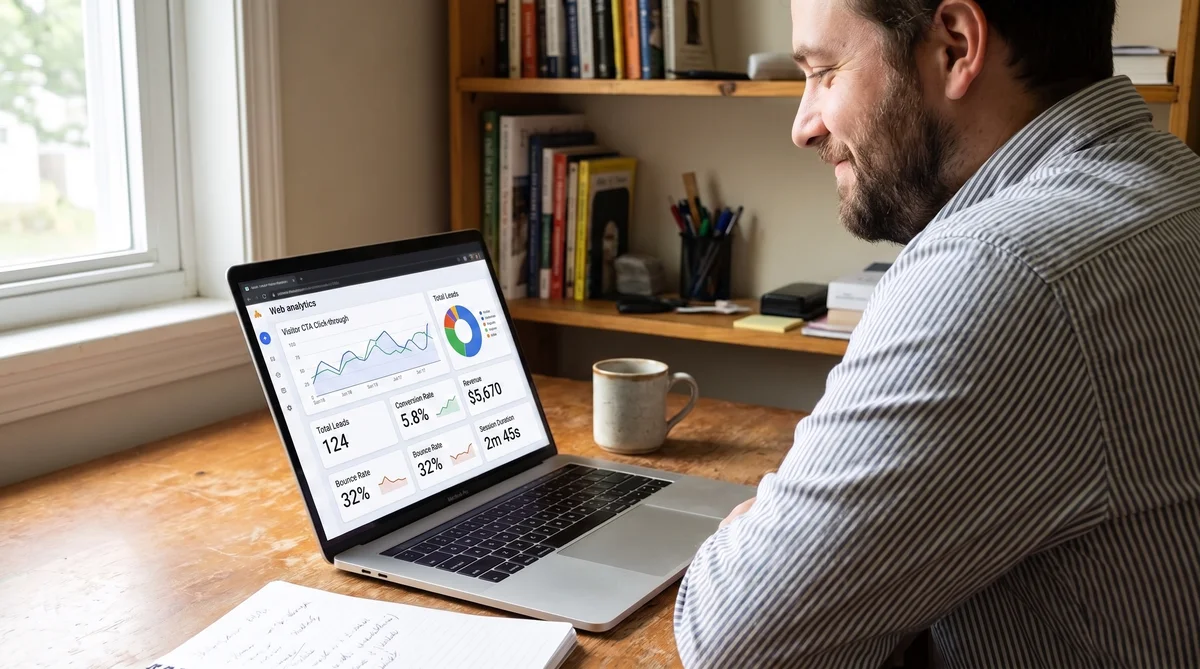
Most small business websites have a "Contact Us" page with a basic form. That's table stakes. A website that pays for itself goes further.
We set up lead capture in layers. The primary conversion is a short form or booking link above the fold on the homepage. Then there's a secondary capture on service pages, something more specific like "Get a Free Quote." And then there's a passive capture, like a downloadable guide that collects emails for follow-up.
The key is making it effortless. Three fields maximum on mobile. Instant confirmation. And an automated follow-up that goes out within minutes. When someone fills out your form at 10pm, they should hear from you before your competitors even see the notification.
Business owners focus on the cost of building a website, but they rarely calculate the cost of not having one. Let's think about that.
Every time someone Googles your type of business and finds a competitor with a professional site instead of you, that's a missed lead. Every time someone hears about you from a friend and looks you up online only to find nothing, that's lost credibility. Every time a potential client visits your outdated site and assumes you're not a serious operation, that's revenue walking away.
We've had clients tell us they were embarrassed to share their website URL. That's a business problem, not just a design problem. Your website is often the first real impression someone has of your company. If it doesn't reflect the quality of your work, you're starting every relationship at a disadvantage.
If you're thinking about upgrading, our guide on website redesign covers how to do it without losing the search traffic you've already built.
In 2026, designing for desktop first and then adapting to mobile is backwards. Your website should be designed for the phone screen first and then scaled up for larger screens.
This matters for small businesses even more than enterprise companies. Your customers are searching on the go. They're looking for a plumber while standing in a flooded basement. They're comparing contractors from a job site. If your website doesn't deliver a fast, clean experience on a phone, they're gone.
When it comes to choosing an agency to build your site, ask to see their mobile work first. If they show you desktop mockups before mobile ones, that tells you something about their priorities.
If you want to see what a revenue-generating website looks like for your business, reach out and we'll walk you through what it could do for you.