Hiring a web designer is worth it when your site is a main source of leads, bookings or credibility. AI builders now produce a presentable one-page site in an afternoon, but they skip site structure, conversion paths, local SEO setup and accessibility. Testing an idea? Build it yourself. Depending on search traffic? Hire a designer.
You can have a website live tonight without speaking to a single person. Type a prompt, pick a layout, publish. The question owners keep bringing us is whether that site will do the job a business actually needs a website to do, or whether it is still worth paying a human to build one.
We have built websites since 2021 on Webflow, WordPress and Shopify for clients across Canada, and we use AI tools inside our own process every week. So this is not an argument that software is bad or that designers are sacred. It is an honest accounting of what AI builders now do well, what they still leave out, and which of those gaps matter for a trades business, a restaurant or a professional services firm in New Brunswick and the rest of Atlantic Canada.
If you are weighing a DIY or AI build against hiring a designer, this guide walks through both sides and ends with five questions that settle the decision in about five minutes.
Yes, AI can build a website, and it can do it in one sitting. What it builds is the surface: a layout, generated copy, placeholder-grade images and a contact form that may or may not reach a real inbox.
In our experience, an AI website builder or a template gets you a presentable one-page site in an afternoon. For a business testing an idea, or one that mainly needs an address, hours and a phone number online, that is a genuinely good outcome and nobody should talk you out of it.
What these tools consistently skip, in the projects we have seen, is everything underneath the surface:
There is also an accuracy problem. Google Search Central notes that generative models do not retrieve facts, they predict a likely sequence of words, so outputs may contain inaccuracies, and it describes manual factchecking and review of all AI-generated content as critical before publishing. That review extends to metadata like title elements, meta descriptions, structured data and image alt text.
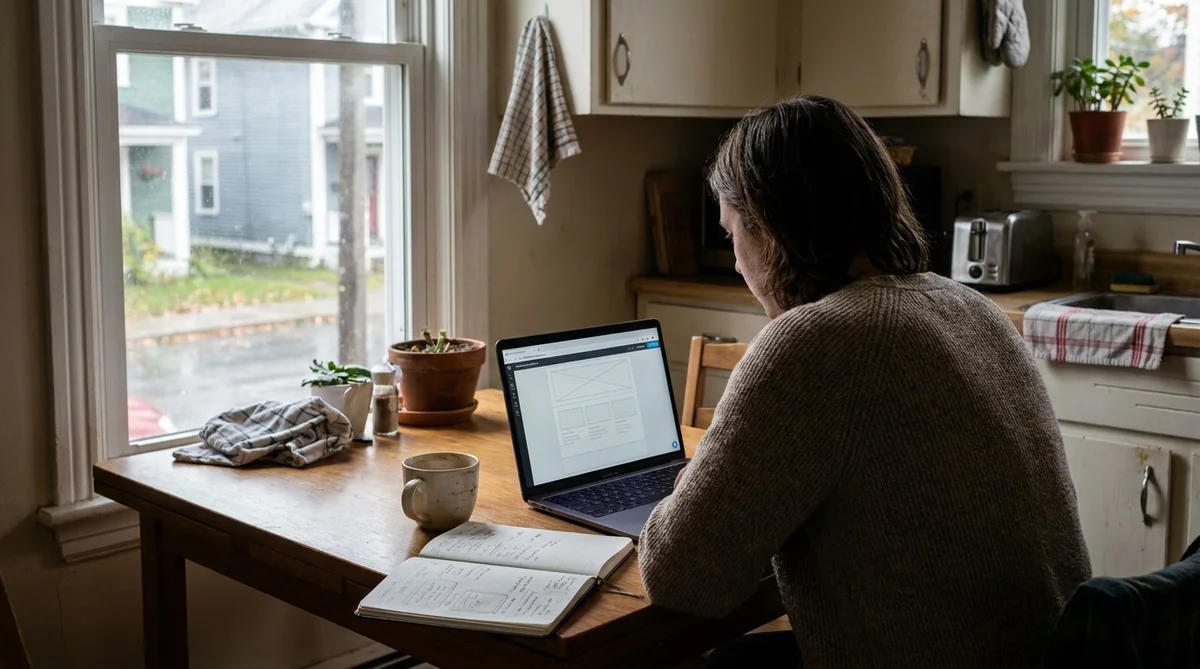
A web designer decides what the website has to do before deciding what it looks like. That decision work is the part a tool cannot do for you, because it depends on your offer, your customers and how many jobs you can actually take on next month.
The job, in order:
That list is the honest answer to what a web designer does, and it is close to what our web design process actually covers. A prompt produces a page. This produces a system that sends you work.
Yes, when you measure it by customers rather than by pages. A site that costs nothing and produces nothing is more expensive than a site that costs money and produces enquiries every week.
The spend is real either way. BDC reports that Canadian businesses with less than $2 million in annual sales invested an average of $19,652 in their website over the last three years. Against numbers like those, the real question is which version of the spend brings in work.
Ranking is part of that return, and it is not magic. Google Search Central states plainly that there are no secrets that automatically rank a site first, and that sites following the Search Essentials are more likely to show up in Google's search results. Structure, crawlable content and clear pages are the work.
The mistake we see most often is owners comparing a cheap template site to a custom build as if they were the same product with two price tags. They are not. The template site is usually rebuilt within two years.
Sometimes building it yourself is the correct business decision, and we will say so on a call. If the website is not yet carrying weight, paying a team to design it is premature.
Build it yourself when:
The condition in all six cases is the same: the site is not your main source of customers yet. The moment it becomes the thing that fills your calendar, the economics change and so should the approach.
Hiring pays for itself when the website is a working part of the business rather than a brochure. If leads, bookings, intake or sales run through it, every structural weakness costs you money quietly.
Four situations where we see the spend return:
Hopscotch Whisky Bar in Saint John is a useful example of the middle ground. We built a site the owner updates himself, so he gets the editing convenience of a builder with a professional structure underneath. Four years later he came back for a redesign when the bar expanded. You can see more client results from past website projects.
On cost: our business website projects typically begin around $5,000 CAD, quoted as one fixed price after a free consultation, with no hourly billing.

We use AI every week, and we are specific about where. It speeds up first drafts of page copy, image concepts, code scaffolding and research, which is the part of the work that benefits from volume.
A person still decides the page structure, the offer, the words a customer actually reads and, most importantly, what gets cut. That last one is where generated output tends to fail: it adds, it rarely subtracts. Both of our own products, Linkroo and Benzy AI, were built with AI tools in the loop and a human making the calls, so this is how we work on our own time too.
This matters for your decision in a practical way. When you hire a designer today, you are not paying for someone to type slowly. You are paying for judgement about what the site needs to say, in what order, and for someone accountable when a form breaks three months after launch. The same split applies to how we apply AI and automation for clients: the tool does the repetitive part, a person owns the outcome.
If a studio cannot tell you where AI sits in their process, that is a fair question to ask before you sign anything.
Answer these five honestly. Three or more yes answers means hiring a web designer will likely pay for itself; fewer means build it yourself now and revisit in a year.
Write your answers down before you price anything. Most owners find the result is obvious once the questions are on paper, and it is not always the answer they expected walking in.
The honest answer is that AI changed the floor, not the ceiling. Anyone can now get a decent-looking page online in an afternoon, which removes the excuse for having no website at all. What AI has not changed is the harder work: deciding which pages exist, what the offer says, where the enquiry happens, whether the site is accessible, and whether your business shows up when someone in your city searches for what you sell.
So apply the five questions. If your site is a business card, build it yourself and spend the money elsewhere. If it is the thing that fills your calendar, hire someone accountable for the result.
Book a free consultation with our team in Saint John and we will tell you honestly which side of that line you are on.