
Google AI Mode is a separate tab in Google Search that answers a question with a full AI-written response and a short list of source links, and it has been available in Canada in English since August 21, 2025. For a firm, it means fewer clicks on simple questions and more value in being one of the sources Google cites.
Someone researching a car accident claim, an estate or a tax deadline types a long, specific question into Google. Instead of scanning a page of links, they can open a tab that writes the answer for them and lists a handful of supporting websites underneath. Some of those people will never visit a firm's website. Others will arrive already persuaded, because the firm was one of the sources behind the answer.
That tab is Google AI Mode, and Canadian searchers already have it. With a Google core update rolling out this November, the obvious question is whether to rewrite the website before traffic shifts.
The honest answer is that most of the work is the SEO groundwork a firm should already be doing, measured in a new place. Below, we cover what AI Mode is, what it changes for a firm's traffic and how Google picks its sources. We also give you a checklist for what to do now, explain how to handle the core update and show how we track AI visibility for clients.
AI Mode is a separate tab in Google Search where people ask a full question, read an AI-written answer with links to supporting websites, and keep going with follow-up questions. AI Overviews are the shorter AI summaries that sometimes appear at the top of the normal results page, above the regular links.
Google began rolling out Google AI Mode in Canada in English on August 21, 2025, according to Google's Canada announcement. It appears as a tab on the results page and in the Google app for Android and iOS, and it runs on a custom version of Gemini 2.5. Google calls it its most powerful AI search experience and says early users ask questions two or three times the length of traditional search queries.
Both features can use what Google calls query fan-out. The Google Search Central documentation says AI Overviews and AI Mode may issue multiple related searches across subtopics and data sources to build one response. It also says the two may use different models, so the links they show will vary. Google Search Help adds that when AI Mode is not confident enough in an AI response, it may show a set of web links instead.
| AI Overviews | AI Mode | |
|---|---|---|
| Where it appears | At the top of the regular results page | In its own tab and in the Google app |
| How people use it | A quick summary, then the normal links | A conversation with follow-up questions |
| When it shows | Only when Google decides it adds to classic Search, so often it does not appear | When someone opens the tab and asks |
| Links | Links to explore and learn more | Links to supporting websites beside the response |
Google positions AI Mode for exploration, reasoning and comparing options. That is the kind of research people do before they choose a lawyer, an accountant or a clinic.
Simple questions, such as what a legal term means or how long a process takes, can now be answered inside Google without a click to any website. Searches that end in hiring someone still send people to websites and Google Business Profiles, and being one of the sources Google cites now carries more weight.
It helps to sort the searches that reach a firm by what the person wants to do next.
| Search type | Example | What tends to happen in AI search |
|---|---|---|
| Definition | what is a contingency fee | The AI answer covers it, so a click is optional |
| Process or timing | how long does probate take in New Brunswick | The AI answer covers it, with sources listed |
| Branded | your firm's name | The person goes to your website or Google Business Profile |
| Near me | injury lawyer near me | Local results and Google Business Profiles |
| Service in city | family lawyer in Moncton | Websites and profiles of firms in that city |
The first two rows are where informational clicks can fall away. That is not pure loss. If the AI answer lists your page as a source, the person who does click has already read your explanation and knows your name.
The last three rows are hiring searches. They still depend on a clear website, an accurate profile and a record of genuine reviews, which is why the checklist below starts with fundamentals rather than AI-specific tactics.
For firms with several offices, hiring searches are local by nature. Each staffed office needs its own page and its own profile so Google has something specific to show for the city in the query.
Do not guess the size of the change for your firm. Watch your informational pages in Search Console, and watch calls and consultations from the pages that bring in work.
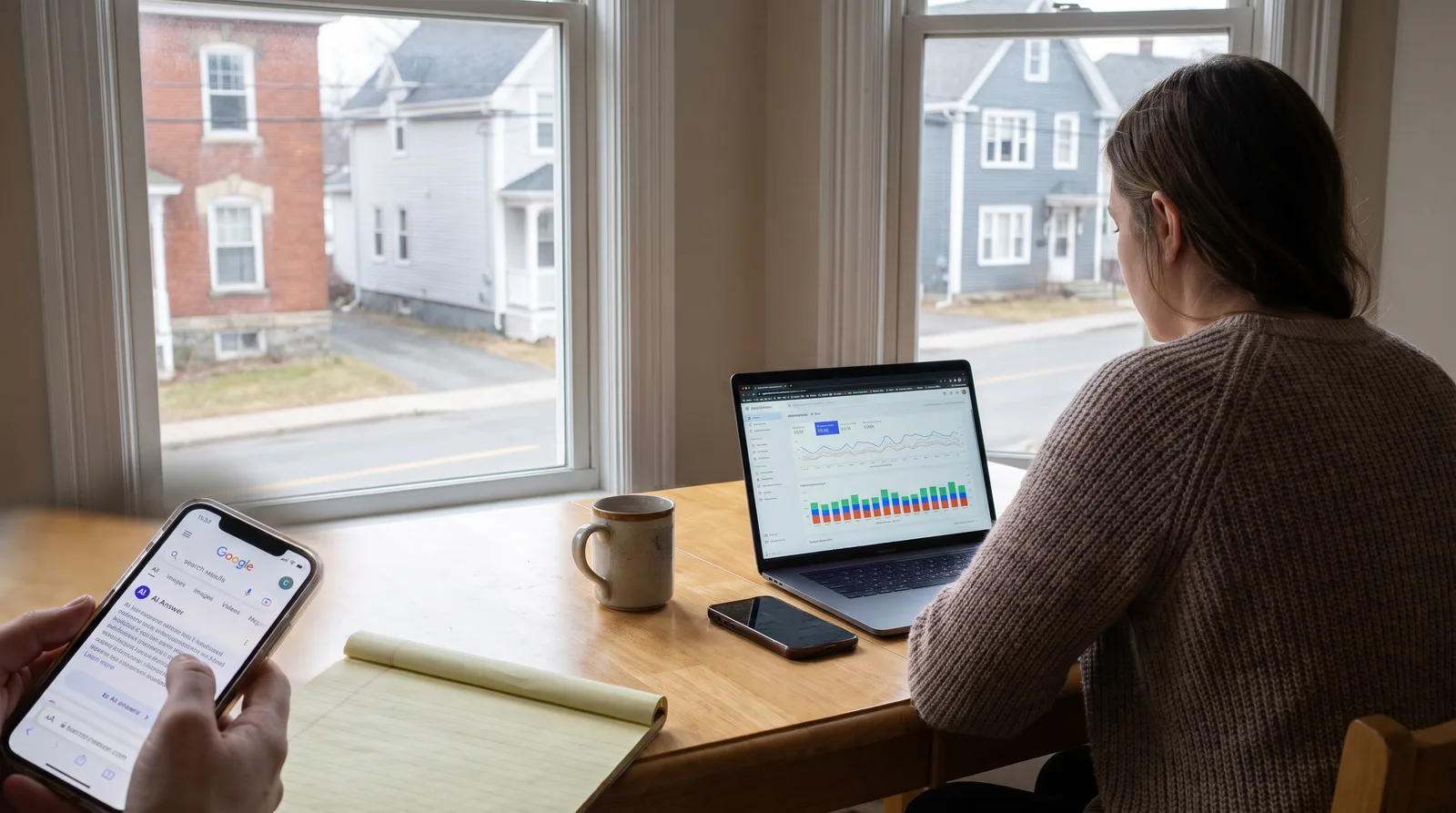
Google picks AI Mode sources with the same systems and quality standards it uses for regular Search, not with a separate rulebook. There are no extra requirements or special markup needed to appear, so anyone selling an AI Mode optimization trick is overselling.
The Google Search Central documentation says site owners can apply the same foundational SEO best practices to AI features that they apply to Search overall. Google's guidance also states that a page must be indexed and eligible to show in Search with a snippet before it can appear as a supporting link, and that no special optimizations are required beyond that. Google Search Help adds that AI Mode responses are supported by high quality web content to improve factuality.
AI Mode breaks one question into subtopics and searches each one. So a page that answers a single subtopic clearly can be pulled into a broader answer. For example, a page explaining how fault is decided after a car accident in New Brunswick can support an answer to a wider question about making an injury claim.
Start with six fundamentals: answer-first pages, consistent contact details, a complete Google Business Profile for each office, genuine reviews, accurate structured data and citation tracking. None of them is new, and each one supports both regular results and AI answers.
If you would rather hand this list to someone, see our law firm SEO service.
Wait for the update to finish before you judge results or rewrite pages. Google began rolling out the November 2026 core update on November 10, 2026, and said the rollout may take up to two weeks to complete.
According to Search Engine Roundtable, Google described it as a regular update designed to better surface relevant, satisfying content for searchers from all types of sites. The same report says it is not a penalty and notes that Google integrates core ranking signals into its AI experiences. So movement in regular rankings and movement in AI answers can be connected during the same weeks.
Rankings shift while an update rolls out. If you change pages mid-rollout, you cannot tell whether a later move came from Google or from your edits.
We track the questions clients ask and record, every month, where the firm is named in AI answers. We report it next to calls and consultations, because a citation matters only when it leads to work.
I'm Nikhil Sharma. I run our SEO and AI search work at DigiBenders after twelve years shipping software, and this is the reporting we use on our law firm SEO retainers:
| What we record | Detail |
|---|---|
| Questions | The questions clients ask |
| Where the firm is named | Google AI Overviews, ChatGPT and Perplexity |
| Reporting | Monthly, next to calls and consultations |
The last row matters most to a managing partner. Citations alone do not pay anyone's bills, so they sit on the same report as the calls and consultations the firm actually cares about.
You can run the same check for AI Mode yourself. Open the AI Mode tab and ask each client question the way a client would phrase it. Add a natural follow-up, then note whether your firm is named and which page is linked. Repeat it each month, because a single check proves little when answers can change.
Classic search results still count alongside all of this. For Moss Hachey Law, a past client in Fredericton, Google Search clicks grew from 200 to 600 per 28 days by February 2024 after a local SEO rebuild. If you want this kind of reporting set up for your firm, our SEO services team can scope it with you.

Google AI Mode changes which searches end in a click, but firms do not need a new playbook, because Google picks its sources with the same foundations that already drive regular search. The practical work is to answer real client questions in the first paragraph, keep every office listing and profile accurate, let the current core update finish before you react, and record where your firm is named in AI answers next to the calls and consultations that bring in work. If you want to know how your firm shows up in AI search today, book a free consultation with our team in Saint John and we will walk through it with you.