Modern construction businesses across Canada and the United States are under pressure to handle more projects, tighter deadlines, and stricter compliance standards, all while keeping costs under control. For builders, contractors, and developers, efficiency is no longer optional; it’s a competitive necessity.
That’s where a Construction Project Management and Automation Platform from DigiBenders comes in, a complete digital solution designed to help construction companies streamline project planning, budgeting, field management, and reporting in one unified system.
Many construction firms across North America still rely on manual spreadsheets, emails, and disconnected tools to manage projects. These outdated methods cause delays, data loss, and miscommunication between office teams and on-site workers.
A modern construction project management software centralizes every aspect of your workflow from cost estimation to client communication allowing project managers, site supervisors, and business owners to stay aligned in real time.
With automation, you can:
This isn’t just a management tool; it’s a business growth system that helps you scale operations, reduce errors, and deliver projects faster.
Our Construction Project Management Platform is designed for builders, contractors, and developers who need complete visibility, automation, and control across every stage of their projects, from estimation to scheduling, field tracking, and client communication. Unlike spreadsheets and disconnected tools, this system unifies your data, teams, and workflows into one secure cloud platform optimized for construction operations, budgeting, procurement, and collaboration.

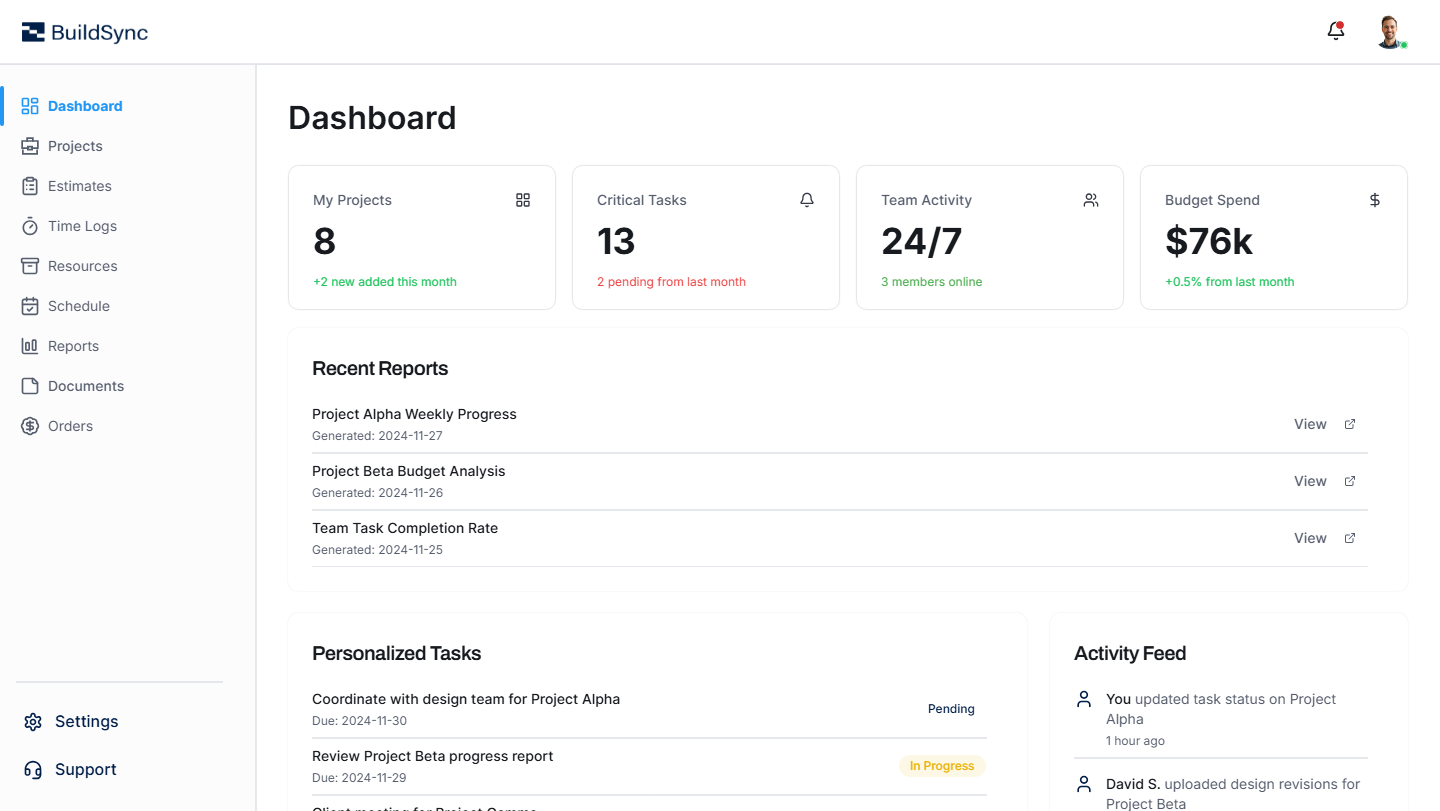
A powerful dashboard provides executives and project managers with a real-time overview of all projects, key performance indicators, and cost trends. Instantly view active projects, critical tasks, team activity, and budget utilization to stay informed at every moment. Recent reports, personalized tasks, and live activity feeds make it simple to track milestones and project health without juggling multiple apps.
Problems solved: fragmented tracking, manual reporting, and lack of real-time visibility.
User outcome: construction leaders make faster, data-backed decisions that keep schedules tight, teams aligned, and margins strong.
The Projects Module provides a clear view of all ongoing jobs, showing status, budget, actual costs, profit margin, completion percentage, and last update.
Filter projects by date, budget, or stage and export reports with one click. Automatic syncing ensures every change, update, and cost entry stays consistent across the system.
Problems solved: inconsistent reporting, manual tracking, and missing data across departments.
User outcome: business owners and operations teams gain accurate, real-time insight into every project’s progress and profitability.

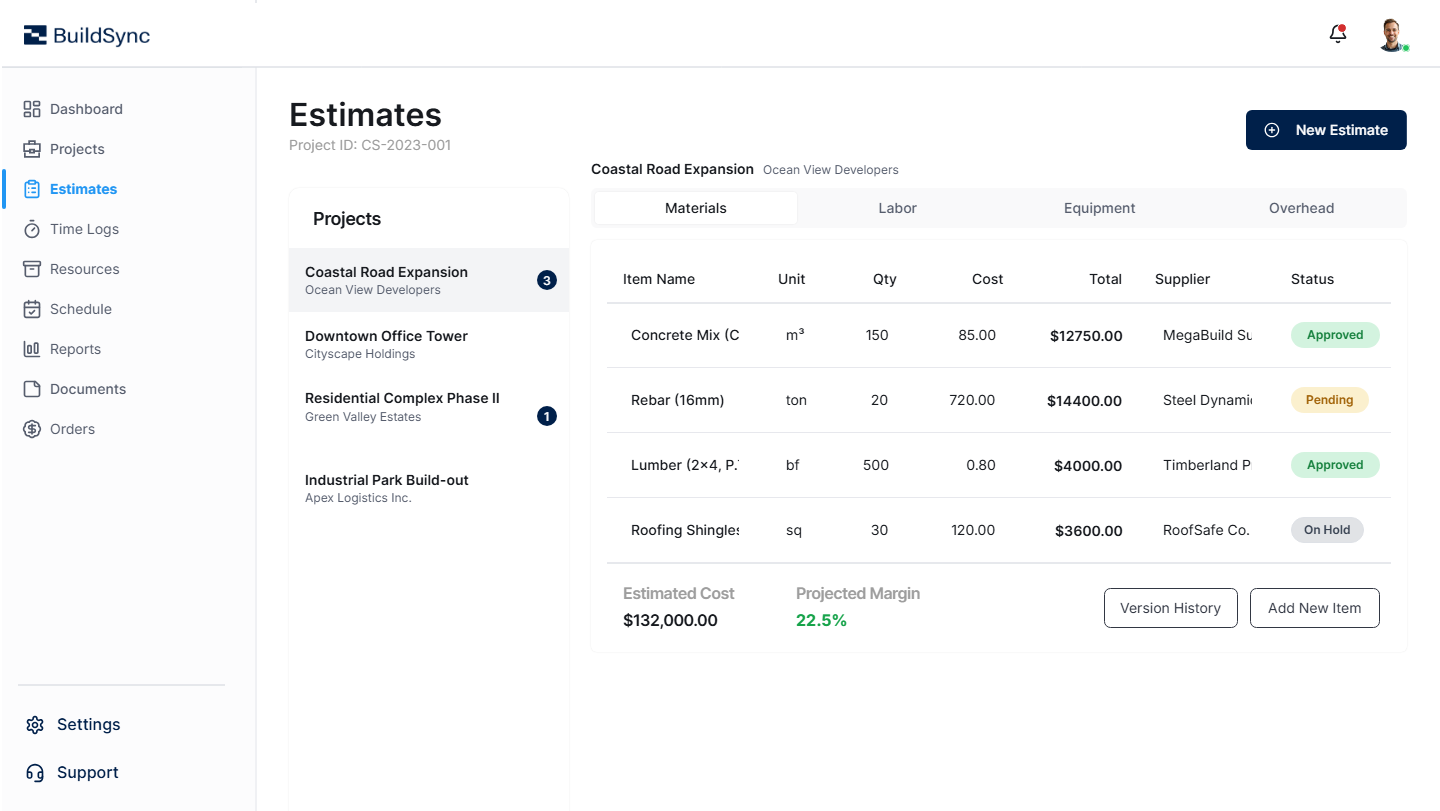
The Estimates Module simplifies the process of construction bidding. Teams can create detailed cost breakdowns for materials, labor, equipment, and overhead using organized tabs. Supplier costs update dynamically, and color-coded approvals make it easy to review progress. Built-in version control allows estimators to track changes over time, reducing human error and improving bid accuracy.
Problems solved: outdated cost data, missed overheads, and inaccurate bids.
User outcome: estimators and managers produce consistent, client-ready proposals that reflect real supplier rates and protect profit margins.
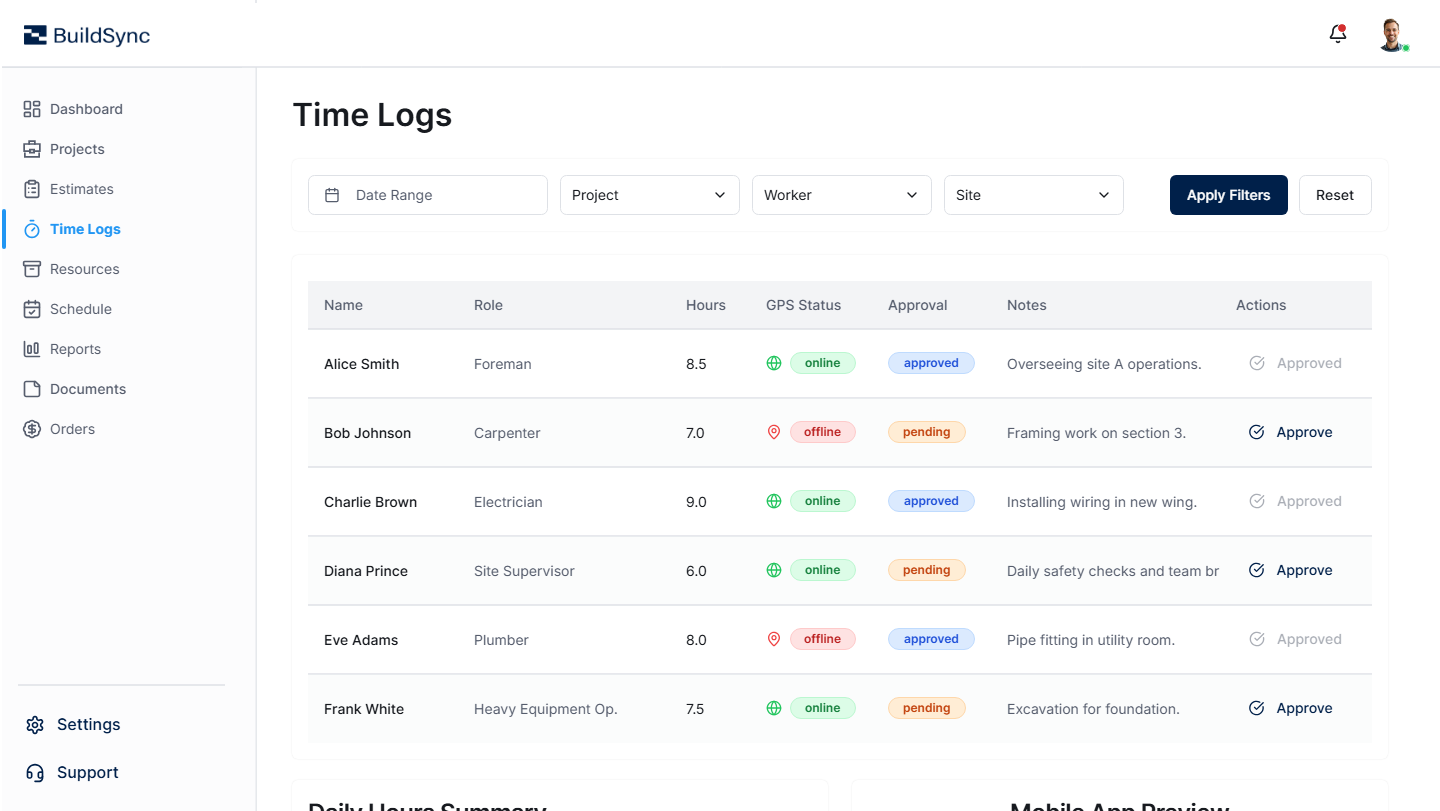
The Time Logs System enables supervisors and project managers to track workforce activity in real time. Each entry logs hours, GPS status, and approval state, ensuring accurate reporting and clear communication between office and field teams.
Problems solved: inaccurate timesheets, delayed payrolls, and weak accountability.
User outcome: project managers gain full visibility over labor performance, job costing accuracy, and workforce efficiency.
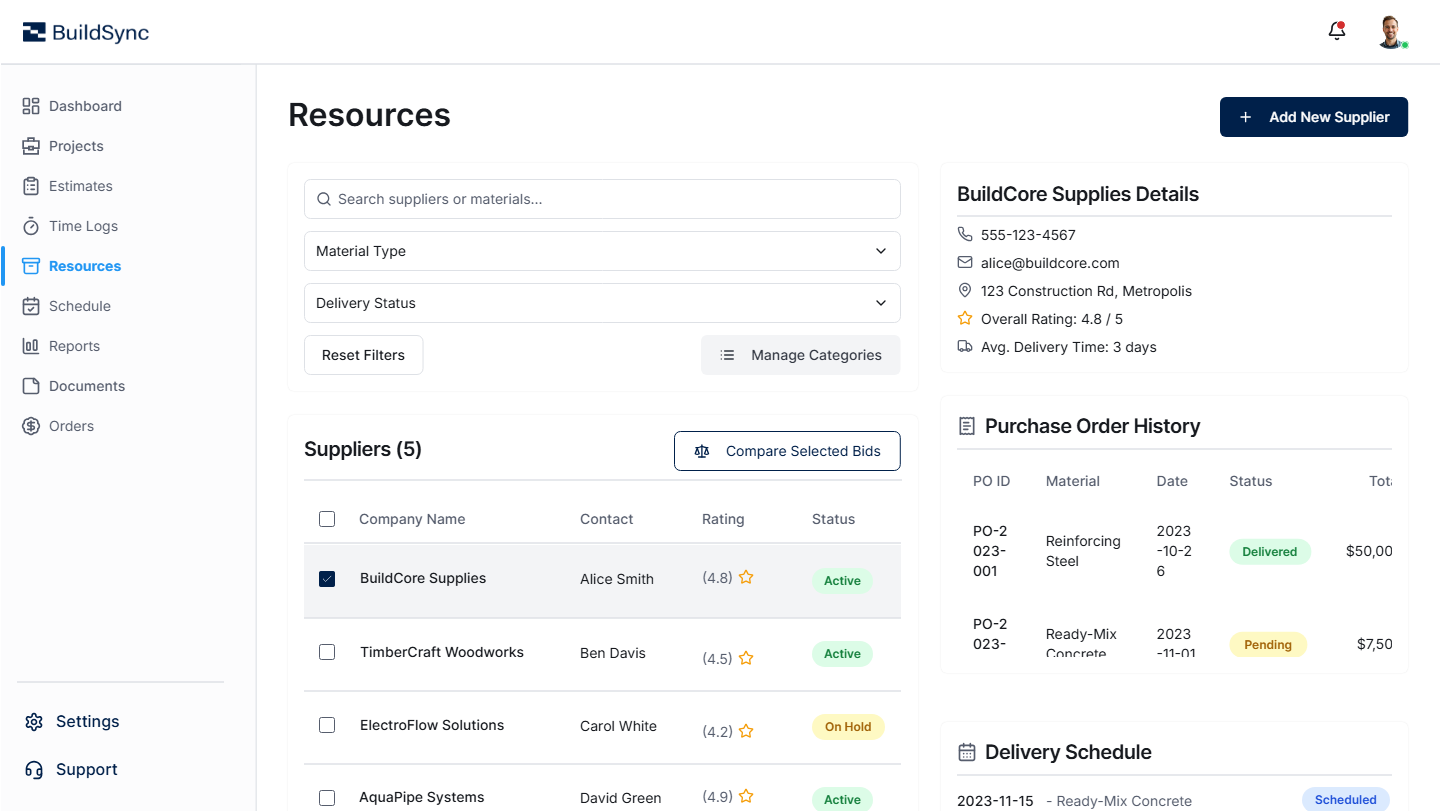
The Resources Panel simplifies procurement and vendor coordination. Manage materials, delivery statuses, and supplier relationships in one place. Compare bids, check contact details, and review supplier ratings and order history to make informed decisions faster.
Problems solved: disorganized vendor communication, procurement delays, and unclear performance tracking.
User outcome: streamlined procurement, improved vendor relationships, and reliable material delivery timelines.
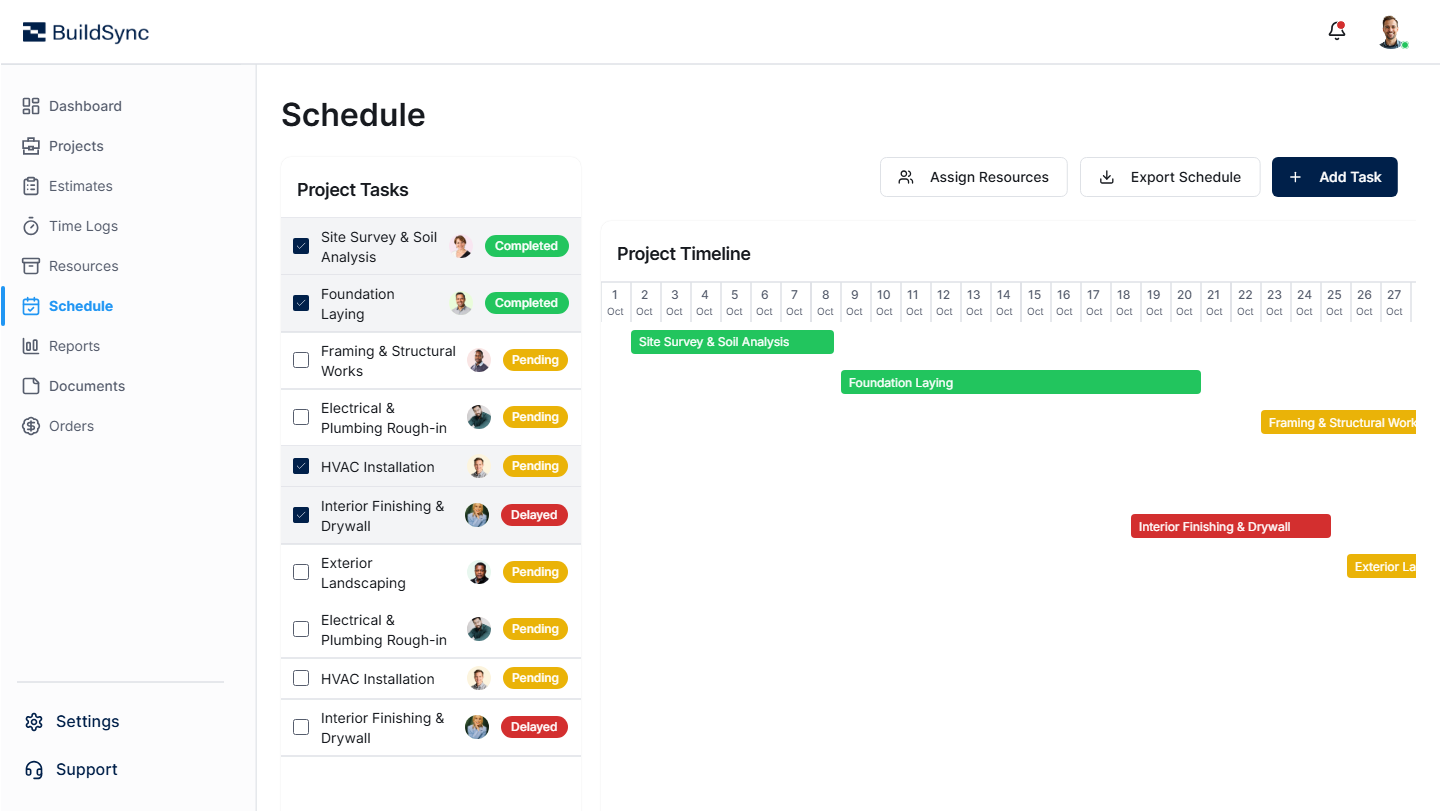
The Scheduling Module makes construction planning simple and visual with an interactive Gantt-style interface. Managers can assign resources, adjust dependencies, and visualize progress using color-coded task statuses such as completed, pending, or delayed. Schedules can be exported or shared easily with clients and internal teams.
Problems solved: missed deadlines, manual rescheduling, and poor timeline visibility.
User outcome: synchronized project execution, clear task ownership, and improved collaboration between field and office teams.
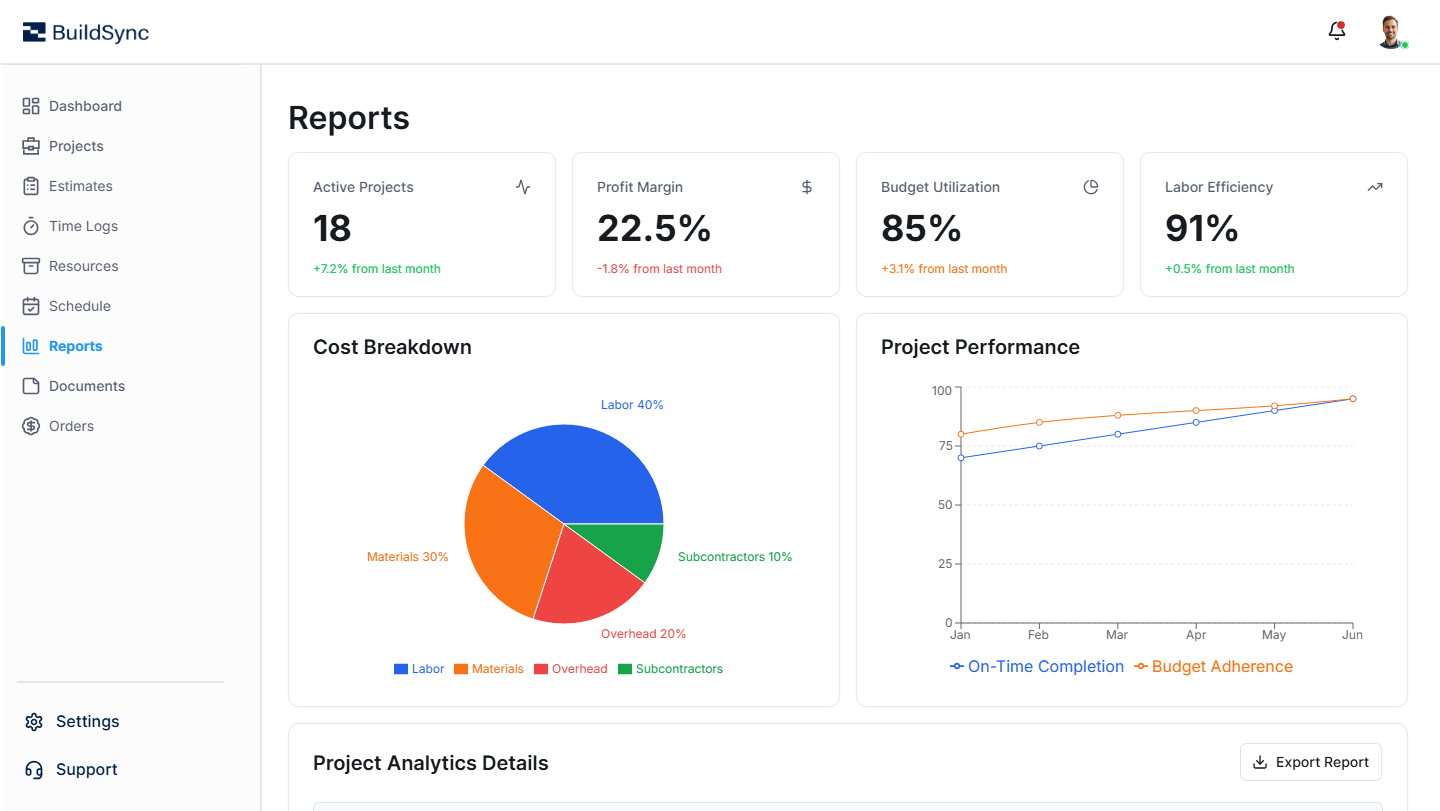
The Reports Dashboard transforms raw data into powerful visuals. View active projects, profit margins, budget utilization, and labor efficiency in real time. Interactive charts and breakdowns help you track costs, performance trends, and operational productivity across all sites. Problems solved: delayed reporting, manual data compilation, and lack of performance visibility.
Problems solved: delayed reporting, manual data compilation, and lack of performance visibility.
User outcome: actionable insights help teams make informed business decisions, improve productivity, and increase profitability.
The Documents Hub centralizes all project files, revisions, and approvals in one organized location. Collaborate directly on files with internal teams or clients, add comments, upload revisions, and approve updates instantly. Every file is stored securely with complete version history and user audit trails.
Problems solved: lost files, scattered communication, and approval bottlenecks.
User outcome: organized document management, faster collaboration, and full compliance for quality assurance and recordkeeping.

The Orders Module streamlines procurement and financial tracking. Monitor every purchase order, change order, and vendor transaction with live updates on status, amount, and linked project. Integration with QuickBooks and Google Sheets automates reconciliation and improves financial accuracy.
Problems solved: manual order tracking, inconsistent vendor payments, and fragmented recordkeeping.
User outcome: seamless financial synchronization, faster vendor payments, and a complete view of procurement activity.

Each user, from executives to field workers, gets a personalized experience. Screens adapt based on user roles, displaying only relevant data and actions. Executives can monitor company-wide performance, project managers can oversee schedules and budgets, and field staff can submit time logs and reports effortlessly. Built-in role-based permissions protect sensitive data and improve organizational control. Problems solved: information overload, unauthorized access, and miscommunication between teams. User outcome: secure, focused, and efficient workflows for every stakeholder involved in project delivery.
Building a custom construction project management platform in Canada and US typically involves multiple modules, from estimation tools and field reporting to scheduling and analytics.
To give you a realistic benchmark, developing an MVP (Minimum Viable Product) version of such a platform generally takes around 1,200 development hours, with an estimated total cost between $120,000 and $155,000 CAD.
Here’s what that includes:
The estimation and budgeting module alone can take about 180 to 220 hours, costing approximately $18,000 to $22,000 CAD, depending on the level of automation and supplier API integrations.
A field reporting and time tracking system, including mobile access for on-site workers, typically requires another 200 to 250 hours, averaging $20,000 to $25,000 CAD.
Features like resource and supplier management, project scheduling with Gantt charts, and reporting dashboards each add about 150 to 200 hours of development, with estimated costs ranging from $15,000 to $20,000 CAD per module.
If your platform includes a secure client portal with built-in e-signatures or a cross-platform mobile app, expect an additional $18,000 to $30,000 CAD, depending on the level of customization and integrations.
Overall, most construction software projects we build for US and Canadian businesses fall in the range of $120,000 to $155,000 CAD for an MVP, scalable later as your operations grow.
Note: Actual pricing varies based on project scope, integrations, and desired features. For an accurate quote, Contact DigiBenders to receive a tailored cost estimate and technical proposal.
Partnering with an Atlantic Canada–based offshore development agency offers the ideal balance between North American quality and global affordability. For construction companies and business owners looking to develop a powerful project management platform, this partnership delivers top-tier expertise, real-time collaboration, and significant cost advantages while keeping your data secure within Canadian borders.
The biggest advantage of working with a development team in Atlantic Canada, including New Brunswick, Nova Scotia, and Prince Edward Island, is the dramatic difference in cost compared to Ontario or U.S.-based firms.
Developers in major cities like Toronto, Vancouver, or New York often charge $120–$180 CAD per hour, driven by high overheads and salary expectations. In contrast, Atlantic-based developers average between $60–$90 CAD per hour while maintaining the same technical skill, English fluency, and communication standards.
That’s a 25–50% overall project savings, allowing your business to invest those funds back into growth, whether it’s marketing, scaling your product, or hiring more staff.
For example, a $150,000 build in Ontario could be completed for around $80,000–$100,000 by an Atlantic Canada partner without sacrificing communication, reliability, or quality.
Atlantic Canada is home to a thriving tech ecosystem fueled by world-class universities, a growing innovation sector, and high retention rates among skilled professionals.
You’ll be working with experienced Canadian developers, designers, and engineers who stay long-term on projects, ensuring continuity, reliability, and ongoing support that large urban agencies or transient overseas teams can’t match.
Lower regional living costs mean these savings flow directly to clients, making it one of the most efficient ways to build high-quality software within Canada.
Unlike overseas outsourcing, partnering with a Canadian-based offshore team eliminates communication delays and cultural barriers. You get real-time collaboration, same-day feedback, and aligned working hours across both Eastern and Central Canada, as well as the U.S. East Coast.
This alignment is especially valuable for construction firms that operate on tight schedules and require rapid iteration, progress updates, or design approvals. With your development partner in the same time zone, you maintain speed without losing control.
All development work conducted in Atlantic Canada adheres to Canadian privacy laws (PIPEDA) and national data protection standards. This ensures every contract, document, and client record remains within Canadian jurisdiction, offering stronger compliance and peace of mind than overseas outsourcing, where data often crosses borders and lacks transparency.
The tech community in Atlantic Canada is known for stability and integrity. Instead of high-turnover freelancer networks, you’ll be working with established small teams and agencies that prioritize long-term client relationships over short-term profit.
Your project won’t get lost between time zones or layers of management. You work directly with the people designing, developing, and maintaining your platform. That means faster decisions, better understanding of your business, and continued evolution as your needs grow.
Choosing an Atlantic Canada development partner isn’t just about cutting costs. It’s a strategic business decision. You gain access to experienced Canadian talent, transparent communication, and compliance you can trust, all at a fraction of what it would cost to hire a team in Ontario or the U.S.
If you’re a construction business owner looking to build a custom project management or automation platform, working with an Atlantic-based offshore partner gives you:
At DigiBenders, we help construction companies across Canada and US digitize their operations, reduce costs, and boost profitability with modern, scalable software solutions.
Whether you’re managing multiple projects, overseeing subcontractors, or aiming to automate your reporting process, our team can deliver a platform tailored to your exact needs.
Contact Us today to discuss your construction software project and receive a detailed pricing estimate based on your business goals.